NetObjects
Co-Founder & Chief Creative Officer
NASDAQ (NETO)
Redwood City, CA
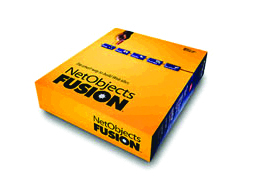
During the early years of the Internet boom, designers had few tools for building websites and were often required to learn HTML and programming. In 1995, I had the opportunity to develop a website-authoring tool for the “technically challenged”—an application that looked and behaved like desktop publishing software. This is the story of my participation in a Silicon Valley startup, from its founding to its eventual closure, and the lessons I learned along the way.
Founded in November 1995, NetObjects, Inc. was initially a privately held company funded by IBM, Norwest Venture Capital, Venrock Associates, and other private investors. The company brought together a unique combination of design, technology, and business expertise. Its founders came from Rae Technology Inc., a developer of personal information management (PIM) applications, and Studio Archetype, an identity and information architecture consulting firm.
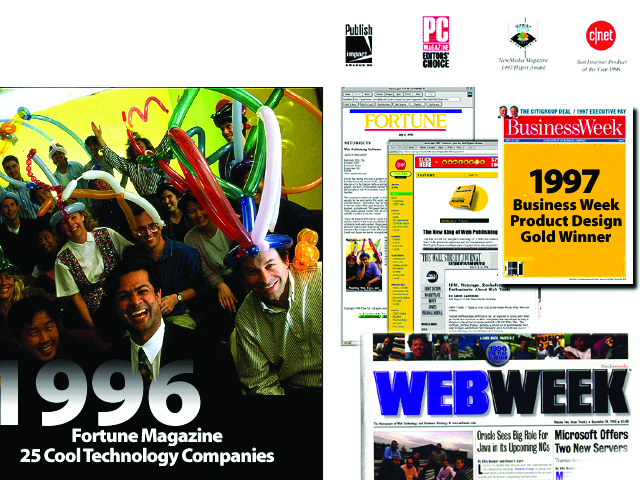
The company’s first products earned “Product of the Year” accolades from reviewers and customers. For a time, between 1996 and 1997, NetObjects Fusion was the cross-platform web design and development tool of choice.
Despite its early success, the company invested heavily in developing new products and building the technical infrastructure needed to support a fickle customer base. Keeping pace and maintaining leadership in an emerging product category was expensive. To expand its market share and raise working capital, NetObjects went public in 1999. With software giants such as Microsoft, Adobe, and Macromedia competing for the same market, NetObjects ultimately sold the business and closed its doors in 2001. It was a good run while it lasted.
The journey taught me about supply-chain management and the rigorous discipline required to design, build, and market software. The success of our initial products reinforced my belief that design can play an important role in shaping and guiding how people interact with technology. The experience also made me a better designer by giving me firsthand experience in making difficult business decisions.
Background on Company
In 1995, Studio Archetype was designing the user interface for a Wells Fargo online banking project. Rae Technology was brought in to prototype the electronic commerce application. Using SOLO (Structure of Linked Objects), a proprietary programming language based on an object-oriented architecture, Rae Technology produced a working client-software prototype in just six weeks. For anyone familiar with developing software applications, this was unheard of.
At the time, the Mosaic browser had recently been introduced, and it was clear that we needed to address the emerging Internet opportunity immediately. Wells Fargo approached Rae and asked whether the company could use SOLO to prototype the same banking application for the web.
SOLO was based on the idea that every piece of data should accommodate navigation and contextual inheritance within a database environment. In layman’s terms, every piece of text, graphic, or page contained an implicit navigational framework based on how the elements were grouped and organized. For example, an image treated as a data object in this programming environment automatically understood the concepts of “next” and “previous,” without requiring an explicit line of code. This greatly simplified the development process.
Because the information architecture and business-logic models had already been completed for the client software, converting it into a web application was largely a matter of recompiling the code for a different delivery platform. We completed the project in four weeks and were stunned by how simple the process had been. It was an important proof point, demonstrating the portability of our technology for cross-platform development.
It wasn’t long before we realized that SOLO, with its foundation in information-organization models, could be adapted to create an application for building websites. We immediately developed a prototype, followed soon afterward by a business plan to raise venture funding. NetObjects was born.
Product Development
In any effort to develop a software product, it is important to understand customers’ needs—not only the features they want, but also how they work. We had a real advantage in this pursuit: we could draw on the practical experience gained through the 24 Hours in Cyberspace event and Studio Archetype.
What set NetObjects Fusion apart from other Internet-authoring software was its focus on the user model. Our goal was to make complex—or seemingly impossible—tasks usable and relevant. Developing the product required us to understand the challenges and frustrations that website creators encountered when building a site.
The challenge was that websites continued to evolve in size, depth, graphical sophistication, and functionality. Building a website was tedious, time-consuming, and expensive, while the available authoring tools were too limiting. Most were little more than glorified word-processing applications. They were either restricted to a page-based model or not open enough to accommodate rapidly changing technology.
Creating a breakthrough site-building product required a new model. Retrofitting technologies and products built for a different paradigm or medium would not deliver radical improvements in ease of use.
The tool needed to be scalable enough to support increasingly large and complex websites. It needed to support information design explicitly, allowing authors to structure content across an entire site. It needed an intuitive graphical interface that concealed unnecessary complexity while providing access to sophisticated functionality. It also needed to support all major standards and platforms, offer the depth required by advanced users, and—most importantly—automate and simplify the processes of designing, authoring, publishing, and updating websites.
These ambitious goals required unconventional strategies and tactics, as well as inventive thinking and a disciplined ability to focus. Many of the product’s key features emerged simply from observing and interviewing experienced website builders.
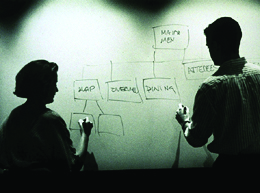
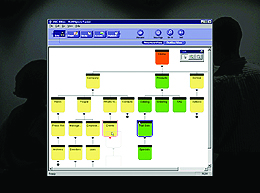
The idea of an application that accounted for a website’s overall structure grew out of a mapping practice Studio Archetype had developed to communicate the full breadth and depth of a site to its clients. The concept of Site View came from our belief that users should be able to see an entire website at once, just as presentation software lets them view a complete presentation, rather than working page by page as they would in MacDraw.
The requirements for pixel-level control and WYSIWYG editing formed the basis of NetObjects Fusion’s page-layout capabilities. Editing web pages in enhanced word-processing applications was, at best, a dysfunctional model for serious website development. The layout tools needed to be as sophisticated as those in PageMaker, QuarkXPress, or Macromedia Director.
NetObjects also focused on the needs of “graphically challenged” and “technically challenged” users. Most website developers had neither graphic-design nor engineering degrees. Providing a library of professionally designed and programmed websites helped lower the barrier of intimidation inherent in building a site.
NetObjects Fusion
NetObjects Fusion 1.0 for Windows was launched in the summer of 1996 to extraordinary critical acclaim. An InfoWorld review even described the product’s shortcomings as insignificant. This was a big deal.
Fusion won numerous awards and captured the enthusiasm of technical newcomers rather than only early adopters and technology experts. With both breadth and depth, it had the potential to become a mainstream product.
The Macintosh version was launched in November 1996, followed four months later by NetObjects Fusion 2.0 for Windows. Although designers and developers were among its customers, business users—many of whom were building their own websites—accounted for 80 percent of purchases at the time.